28Sep 26
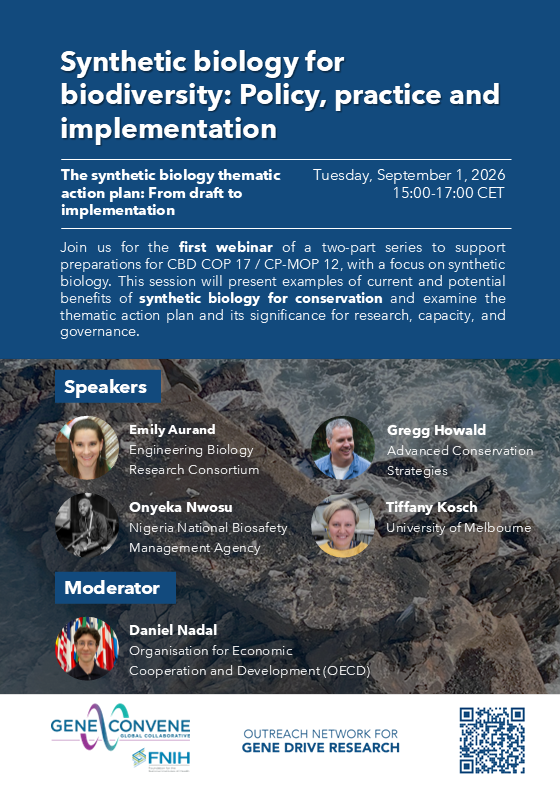
The first webinar of a two-part series, Synthetic Biology for Biodiversity: Policy, Practice, and Implementation, took place ahead of the Convention on Biological Diversity (CBD) COP 17 / CP-MOP 12. Co-hosted by the Outreach Network for Gene Drive Research and FNIH’s GeneConvene Global Collaborative, the webinar created space for practical and informed exchange on the draft synthetic biology thematic action plan and what its implementation could mean for research, capacity building, governance, and biodiversity conservation. The session brought together perspectives from policy, biosafety, and conservation.
The session began with a presentation by Dr. Emily Aurand, Engineering Biology Research Consortium, who provided an overview of the synthetic biology thematic action plan. She outlined the intended audiences, guiding principles, implementation, and proposed outcome areas of the thematic action plan, which include strengthening capacity for synthetic biology research and assessment, improving access to and transfer of relevant technologies, and enhancing knowledge-sharing on synthetic biology development, governance, and regulation. Dr. Aurand also highlighted opportunities to strengthen technical research capacity for regional impact, open-source technology development, education, and workforce development.
Next, Onyeka Nwosu, National Biosafety Management Agency, examined critical gaps in synthetic biology research and capacity across the African continent. Describing synthetic biology as a technology of the present, Nwosu highlighted Africa’s growing landscape of biosafety frameworks, genome editing research, and emerging innovation hubs. He pointed to an “innovation paradox”, noting that African countries are often positioned as regulators of synthetic biology rather than as co-developers of its potential applications. Addressing this will require investment across the research and innovation value chain, from laboratory infrastructure and sequencing to bioinformatics, computational biology, regulatory science, and specialised expertise.
Gregg Howald, Advanced Conservation Strategies, explored the role of synthetic biology in managing invasive species to prevent extinctions. Invasive species are a leading cause of extinction on islands, and their removal can support ecosystem and native species recovery. He noted that more than 1,000 successful invasive alien species eradications on islands worldwide have demonstrated the conservation benefits of this approach; however, scaling these interventions across more than 400,000 islands globally remains a significant challenge. To address this issue, he highlighted emerging approaches such as environmental DNA (eDNA) for biodiversity monitoring and genetic biocontrol, as well as gene drive technologies being explored for population suppression. He emphasized that advancing these technologies will require investment in research, stronger regulatory frameworks and capacity-building, collaboration, and effective science communication.
Finally, Dr. Tiffany Kosch, University of Melbourne, provided another conservation perspective, focusing on genetic strategies for enhancing amphibian resilience in a changing world. Using chytridiomycosis as a case study, Dr. Kosch described research exploring how conservation breeding, selective breeding, and genomic selection could help increase disease resistance in threatened amphibian species, including the corroboree frog. Kosch also emphasized that moving towards field applications would require careful consideration of ethical, social, and logistical issues. She noted that early engagement is therefore essential, particularly as public attitudes towards synthetic biology for conservation can be shaped by emotional responses as well as perceptions of potential benefits.
Across the presentations, a common theme emerged: the conversation around synthetic biology and biodiversity is not only about what these technologies can do, but also about the importance of having the necessary systems in place to explore their potential responsibly. Research and technical capacity, regulatory expertise, evidence generation, knowledge-sharing, and meaningful engagement will all be important as countries consider how synthetic biology can contribute to biodiversity goals.
In his closing reflections, the chair of the session, Daniel Nadal, Organisation for Economic Co-operation and Development (OECD) noted that the discussion had connected policy considerations around synthetic biology with its potential applications and real-world impacts. From addressing the challenge of invasive species to strengthening the resilience of threatened amphibians and building research capacity in Africa, the examples highlighted both the diversity of potential applications and the importance of creating the conditions for informed and responsible decision-making.