28Sep 26
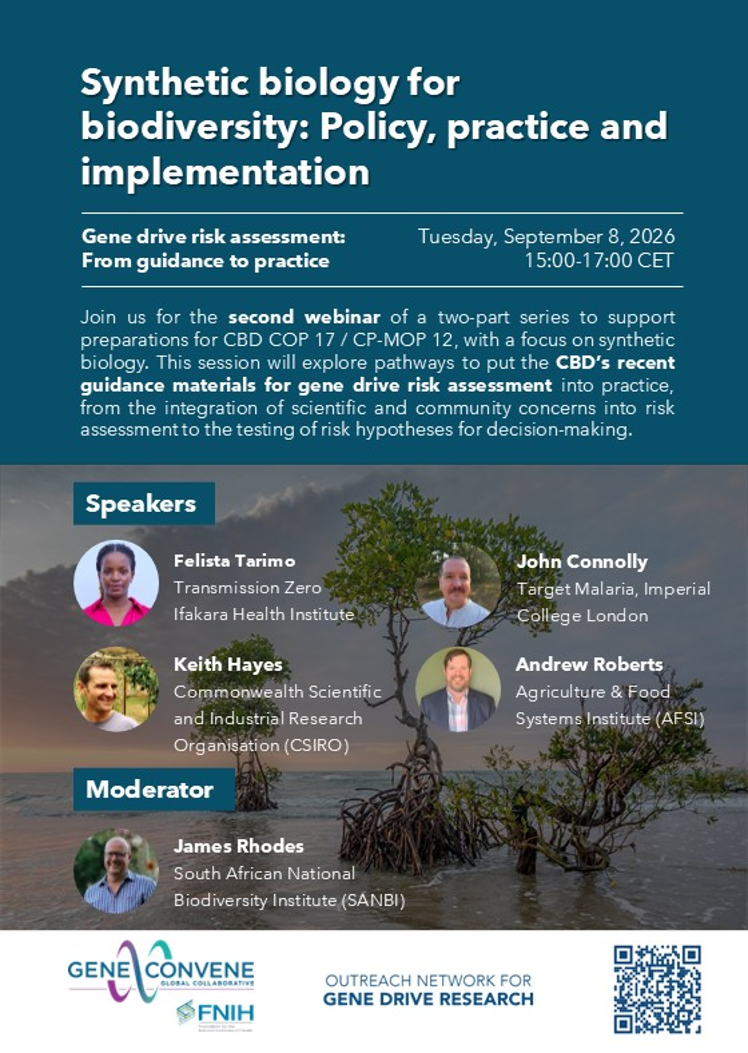
The second webinar of a two-part series, Synthetic Biology for Biodiversity: Policy, Practice, and Implementation, took place on 8 September, ahead of the Convention on Biological Diversity (CBD) COP 17 / CP-MOP 12. Building on the first webinar, this session explored pathways to put CBD’s recent guidance materials for gene drive risk assessment into practice, from the integration of scientific and community concerns into risk assessment to the testing of risk hypotheses for decision-making.
The session, moderated by James Rhodes, South African National Biodiversity Institute (SANBI), began with a presentation by Felista Tarimo of Ifakara Health Institute (IHI) on stakeholder engagement for risk assessment. Drawing on work with communities on Ukerewe Island in Tanzania, Tarimo described several ways researchers can identify stakeholder concerns, including routine engagement activities, stakeholder workshops, community feedback mechanisms, literature reviews and social science studies. She emphasized that engagement could help identify relevant concerns early, bring local and contextual knowledge into the process, highlight uncertainties and knowledge gaps, and ultimately help researchers ask more relevant questions before beginning an assessment.
Dr. Keith Hayes, Australia Commonwealth Scientific and Industrial Research Organisation (CSIRO) then explored how community concerns can be incorporated more directly into risk assessment. He started by providing an overview of the risk assessment framework in CBD’s Additional voluntary guidance materials to support case-by-case risk assessments of living modified organisms containing engineered gene drives, and its points of intersection with stakeholder engagement. Dr. Hayes mentioned that helping stakeholders participate in the risk assessment process is one way to ensure free, prior and informed consent for potentially affected communities. His presentation highlighted the role of stakeholder engagement, as well as examples of opportunities for improved transparency and complementarity between risk assessment and stakeholder engagement teams.
Dr. John Connolly, Target Malaria, began his presentation by providing an overview of existing risk assessment guidance on environmental risk assessment of gene drive technologies. He explained how environmental risk assessments are done; from problem formulation to risk characterizations, as well as the importance of identifying protection goals – or “what we care about”. Protection goals could include for example biodiversity, water quality, human health and animal health. He also emphasized the importance of case-by-case risk assessments as demonstrated in this paper, where problem formulation to identify potential harms or hazards and what we are trying to protect, was used to map 46 plausible pathways to potential harm from a simulated release of gene drive mosquitoes for population suppression.
Finally, Dr. Andrew Roberts, Agriculture & Food Systems Institute (AFSI), focused on testing risk hypotheses and defining what constitutes adequate data. Dr. Roberts stressed that risk assessment is intended to inform decision-making and as a result it is usually a time-sensitive effort. Therefore, it is important to weigh time versus the various questions, data collections and information we want to collect. He emphasized the importance of defining harm before identifying the pathways to harm. His presentation highlighted the idea that while risk assessment is an iterative process, it cannot be endless as it is time sensitive, and some uncertainties might remain.
These presentations helped showcase that moving from guidance to practice is not simply a matter of following a checklist. Risk assessment brings together scientific evidence, policy and regulatory objectives, local knowledge and stakeholder concerns. The webinar highlighted the importance of identifying what matters in a particular context, translating concerns into clear and plausible pathways to harm, testing hypotheses with decision-relevant evidence, and being transparent about both uncertainty and the choices made during the process. As parties prepare for CBD COP17 / CP-MOP12, these practical considerations offer a basis for continued discussion on how the new guidance materials can support risk assessment and informed decision-making for gene drive research.