25Mar 26
Presented at the 39th Ordinary Session of the African Union Assembly, in Addis Ababa, the 2025 African Union Malaria Progress Report, warns that the “perfect storm” of challenges threatening the fight against malaria continues to intensify. Under this scenario, the continent remains off track to achieving the targets of the Catalytic Framework to End HIV, TB and Eliminate Malaria in Africa by 2030.
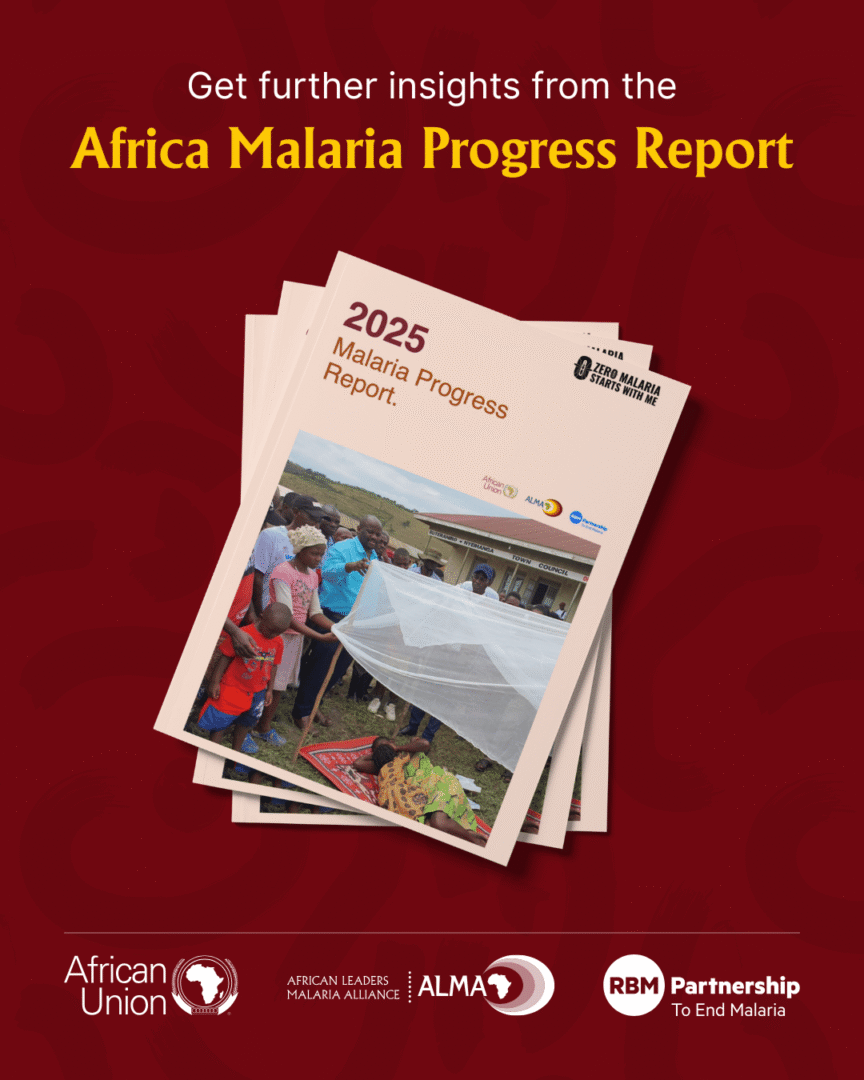
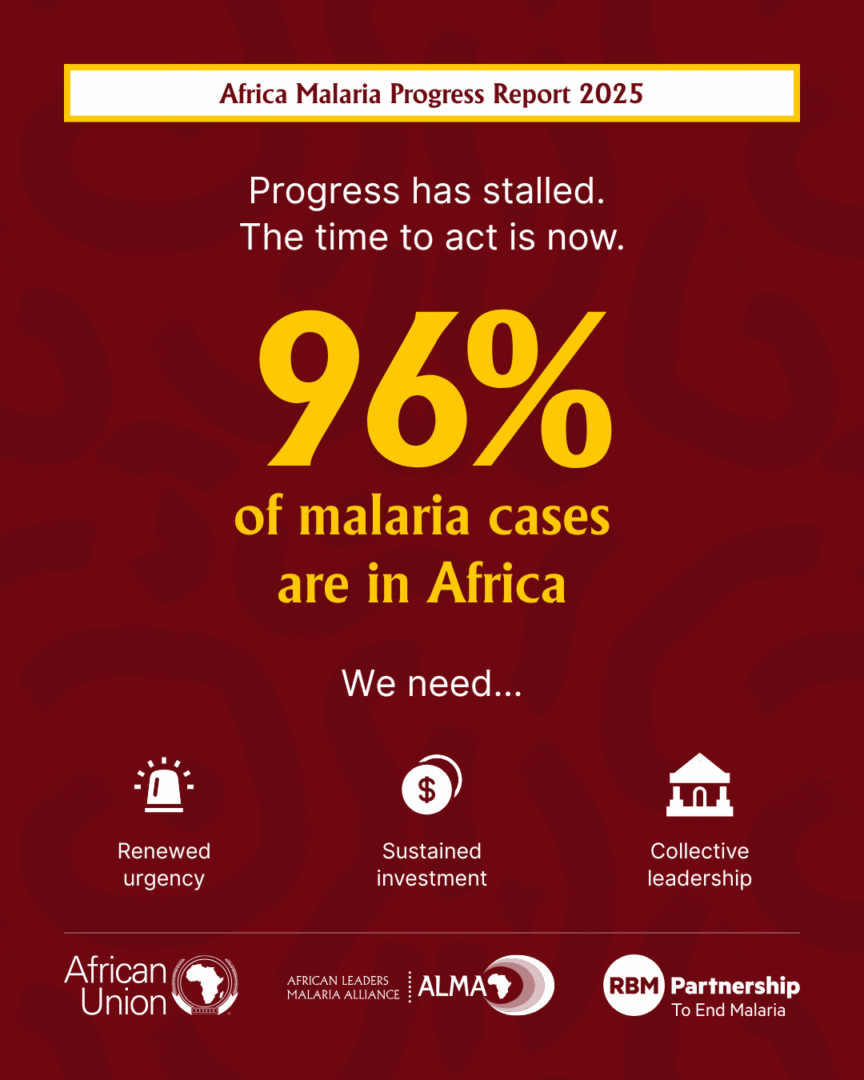
Images: African Leaders Malaria Alliance (ALMA)
The report reveals that African Union Member States accounted for 270.8 million malaria cases and 594,119 deaths in 2024 – representing respectively 96% and 97% of global malaria cases and deaths. Already under financial stress, Member States’ capacity to accelerate progress against malaria was further constrained by declining funding in 2025, with prospects expected to remain tight in the coming years as funding is cut from key donors.
The rise of insecticide and drug resistance, along with the unpredictable effects of climate change, continue to complicate malaria control efforts. Africa’s rapidly growing population – which has doubled since 2000 – further increases the resources needed to prevent, test, and treat malaria. Additionally, malaria remains concentrated in countries affected by humanitarian crises.
The report warns that without urgent action, a 30% reduction in malaria funding could result in 146 million additional cases and 397,000 preventable deaths by 2030. Such a scenario would have profound consequences for Africa’s human capital, economic growth, and social stability, with Member States potentially losing an estimated $37 billion in GDP.
In response to stalled progress, Heads of State and Government endorsed the “African Union Roadmap to 2030 & Beyond: Sustaining the AIDS Response, Ensuring Systems Strengthening and Health Security for the Development of Africa” to accelerate action. Member States and partners have also developed specific priorities to catalyze a “Big Push Against Malaria.”
The priorities include advancing national leadership, accountability, and an integrated malaria response; protecting funding for malaria and advocating for new resources; strengthening data systems and enabling data-driven decision-making; increasing accessibility, acceptability and quality of existing interventions; improving coordination between global, regional, and country partners; and developing and preparing for rapid introduction of new fit-for-purpose tools.
On this last point, the report emphasizes that sustaining investment in research and development, and preparing for the rapid introduction of new tools is essential to accelerate progress and stay ahead of biological resistance. It also underlines the importance of country ownership and leadership, urging malaria-endemic countries to lead the fight and align donor resources and partner support with national priorities.
President Samia Suluhu Hassan of the United Republic of Tanzania underscored this point during a high-level media briefing on sustainable malaria financing held on the sidelines of the Summit and highlighted Tanzania’s efforts to fight malaria, mentioning the work of the Ifakara Health Institute (IHI) on gene drive technologies under the Transmission Zero project:
Our approach has spanned the full spectrum of what it takes to beat this disease. Tanzania has invested in world-class research and is home to the Ifakara Health Institute, where our scientists are working at the frontier of new technologies, including gene drive – an innovative approach that aims to ensure mosquitoes can no longer transmit the malaria parasite. This is African science, conducted by African researchers, addressing an African challenge.
At the African Center for Excellence in Molecular Engineering (ACEME), where I work, we are working to support global efforts to fight vector-borne diseases, such as malaria. Our goal is to place African scientists at the forefront of developing innovative solutions, such as genetically modified mosquitoes, by providing a research platform where scientist can build technical capacity and develop advanced skills in genetic engineering.
The report underscores that malaria is more than a health issue – it is a central pillar of health sovereignty and economic transformation, and should be treated as such by Member States to safeguard and increase both domestic and external funding.