25Mar 26
As part of the Gene Drive Webinar Series, the Outreach Network for Gene Drive Research and ISAAA Inc held a webinar on November 20 exploring the latest developments in gene drive science, governance and stakeholder engagement. The session, which gathered over 120 participants from 30 different countries, offered a timely update on real-world progress, emerging policy discussions, and evolving societal considerations shaping the landscape of gene drive research.
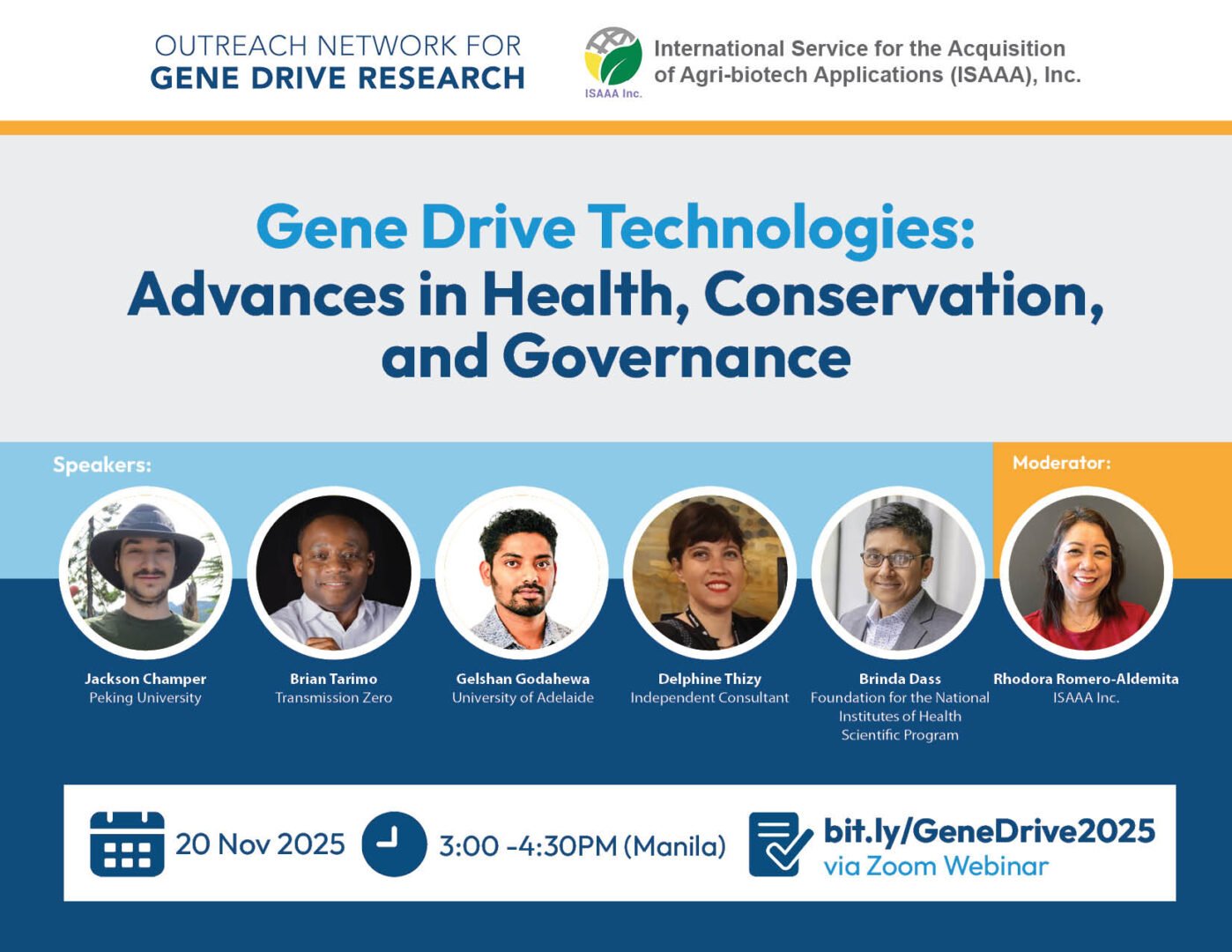
Moderated by Dr. Rhodora Romero-Aldemita, ISAAA Inc, the event began with a presentation by Dr. Jackson Champer, Universidad de Pekín. He explained what gene drive is, and why it is being explored as a potential approach to address health and conservation challenges such as the transmission of vector-borne diseases and the threat of invasive alien species. Dr. Champer delved into the development of a gene drive for population suppression including the challenges that might arise along the way. Up next, Dr. Brian Tarimo, Transmission Zero, Ifakara Health Institute (IHI), emphasized the urgent need for new malaria-control tools in the face of growing challenges, such as drug and insecticide resistance. Dr. Tarimo provided an overview of different approaches being explored and explained how gene drive systems could be leveraged as a potential tool to either reduce the number of malaria-transmitting mosquitoes or prevent mosquitoes from spreading the disease. He also gave an update on Transmission Zero’s work in Tanzania, which is currently still at the laboratory stage but making steady progress toward potential future field trials.
Dr. Gelshan Godahewa, University of Adelaide, explored the potential use of gene drive as a tool to manage invasive rodent populations, mentioning his team’s work on a gene drive system which would target a specific population of invasive mice. He noted that similar research is beginning to extend to other animal species and even plants, although significant challenges remain.
The two final presentations highlighted the importance of robust governance frameworks and proactive stakeholder engagement to ensure ethical, informed, and context-specific implementation of gene drive technologies. Delphine Thizy, Stakeholder Engagement Expert, highlighted that stakeholder engagement is essential for gene drive research. She emphasized the need for case-by-case engagement strategies, as approaches must be adapted to different local contexts. She also explained that an important part of this strategy is the strong emphasis on co-development. This will ensure that stakeholders, especially communities directly affected by the research, actively participate in shaping the research process and its outcomes.
Dr. Brinda Dass, Foundation for the National Institutes of Health (FNIH), closed the session by outlining recent regulatory developments, noting that global bodies such as the Convention on Biological Diversity (CBD) and the International Union for Conservation of Nature (IUCN) are increasingly engaging with topics relevant to gene drive. Among the recent policy developments, she highlighted the voluntary guidance to assess living modified organisms containing gene drives adopted at the Sixteenth meeting of the Conference of the Parties to the Convention on Biological Diversity (COP 16) in Cali, Colombia, and the recent adoption of the first IUCN Policy on Synthetic Biology.